
Archive note: This travelogue first appeared on Pixelarium.cz on 11 September 2014. It has been reconstructed from the final published WordPress version and retains the author’s period voice. This English edition is a new, faithful translation; the old shortcodes have been replaced by current galleries, the original video and waypoints recovered from the map database.
Another instalment in the irregular series of treatises on Santus living upside down—this time from an excursion to the island Kingdom of Tonga. A powerful tale of two advanced users learning to coexist amid tropical heat, beach inactivity, prolonged bar sessions and chance encounters. Our epic begins after yet another arrival in New Zealand, where somebody finally noticed that Santus had been turning up rather too often and wanted to know why he kept crawling back into the country, returning to his native soil mostly to collect Christmas presents.
Before getting to Tonga itself, a short immigration interlude is required to explain how we ended up there. It is not strictly necessary to understand the rest of the story, but if I have gone to the trouble of writing it, you may as well read it. Besides, a socio-psychological study says that readers welcome bad news and unhappy stories more enthusiastically than happy endings. If you recognise yourself in that category, I hope the following passage satisfies your appetite—though you may also wish to consider professional help.
After landing in New Zealand for the third time—this is becoming confusing—I was unpleasantly reminded that the Kiwis have built a remarkably efficient airport snitch-and-hassle system. As on the second visit, the man behind the counter merely smiled at it, took my passport and pointed towards the now-familiar chair where I was to sit until somebody came to conduct the interrogation. The previous time I had spent an hour or so there because I could not remember the house number at which I would be staying. My proposal that they give me Google Maps so I could confidently plant a finger on the correct spot was instantly rejected. Instead they asked for the number of the person—the chief—already present there. All he told them was to inform me that I was an idiot for forgetting Hastings Aerodrome.
So on this visit I proudly wrote Hastings Aerodrome on the immigration form, convinced that everybody would finally be happy. I had no idea how many exciting new problems that could create. They uncovered my cunning new-passport strategy rather quickly—a new passport is not a solution to frequent visits, merely another source of undesirable suspicion, which does not sit well with a low-profile policy. They were equally unimpressed that a tourist had listed some rural airfield between Nowhere and Beyond as his place of residence. The resulting chat with the immigration officer occupied a pleasant four hours.
The interview filled apparent gaps in the already substantial Santus file: how many bedrooms did the hangar contain, what sort of hangar was it, and did we really sleep beside aeroplanes and a helicopter? Their investigation of the hangar interior eventually moved on to subjects about which I, an ill-read and profoundly incurious tourist, knew nothing. The need to hold a confirmed onward ticket had passed me by. At least I possessed enough money to buy one.
This is where the Tonga trip finally begins. The quicker readers already understand; for everyone else: I had to buy a ticket out of New Zealand. Australia was out because I should have applied for a visa before being caught at the airport. A plan to go to Fiji, herd sheep and cross cattle with horses collapsed under the airfare, which even the immigration officer supervising my deportation-shopping exercise considered profoundly un-Christian. I browsed the internet for a while, occasionally muttering about their Windows XP machine and an Internet Explorer 6 installation carrying almost as many “useful” toolbars as the archived specimen below.

At last both the officer and I got what we wanted when I announced triumphantly: Tonga! The idea was received surprisingly well—not only was the fare tolerable, but the officer herself came from the Kingdom. I paid, showed her the ticket, tactfully omitted the fact that it was not one-way, packed my gear and marched out with a tourist stamp authorising me to walk upside down for no longer than three months. That, then, is how Santus acquired a holiday.
That evening he went to represent Czech interests at one of Auckland’s drinking establishments, where he met another temporary emigrant. The man decided to join him and bought the same trip at an even more promotional price. The action duo was complete. The expedition began on 2 April 2013 at half past five in the New Zealand evening, departing Auckland Airport in the general direction of Tonga.
Both participants were anarchic by nature, incapable of accepting outside leadership and unwilling to recognise superior authority, so naming an expedition leader would be difficult. What looked like incoherence from the outside concealed excellent internal coordination. It appeared immediately in our agreement on the permitted import allowance for alcoholic products—two bottles of Jamaican rum—and later in the handling of emergencies and the construction of crisis plans. Despite every effort to present a united front, I cannot shake the feeling that our pair looked like two unusually close male tourists. Or Germans. Possibly unusually close German tourists. Whatever the interpretation, probably nothing flattering.
I shall divide this intestinal tract of a text into subchapters corresponding to the days spent in the Kingdom. You will then have a better overview of the suffering and misery that befell us. The fun began at about half past eight on 2 April, when our backsides touched down at the royal airport. Our first disagreement had already appeared in flight: the other fool had bought some total-budget ticket, received no food, and made me carry his sleeping bag because his cabin allowance was occupied by an analogue camera made from some authentic heavy alloy, a few pairs of underpants, a towel and the rum.
The flight itself was uneventful except for a woman several rows behind who decided to unwrap a child’s loaded nappy directly on the seat just as the aircraft began bouncing. Thanks to the presence of mind of the Air New Zealand crew, we did not have to pass the object between us like a hot potato. Apart from that attraction, my viewing of Top Gear proceeded undisturbed. I reminded my companion in good time that one does not applaud after landing—and there we were.
Chapter 1: Arrival
At the airport we thoroughly surveyed the prices in the duty-free shop, queued at immigration, collected stamps in our passports and continued forwards. Outside, the proprietor of our accommodation—Toni’s Guest House, Green Version—was waiting beside a Transit-shaped carriage. It was already half past eight in the evening and the queue had taken its time, so there was not much to see, but we agreed on one thing: this looked like a proper hole.
We ordered our driver to stop at a shopping centre so we could acquire the necessities for a quality evening. No shopping centre materialised. Instead he stopped beside a small masonry kiosk fitted with bars. I requested two litres of cola for the rum, some local popcorn-like matter and bananas. The first two requests were understood. The banana caused bewilderment. I explained what I meant until they could bear it no longer, disappeared behind the building and returned ten minutes later with two kilograms of bananas. Pay for the other goods, they said; the fruit was free.
Initially I thought I had secured a superb bargain. Then the driver explained that asking a shop for a banana or coconut was not normal here. They simply grow. If you see one outside private land, take it. Thus our daily dinner was settled: we would eat whatever we found. Tonga’s speed limit is 40 km/h in villages and 65 in the wilderness, but our man drove at presidential speed—about thirty, slow enough for me to wave at the assembled crowds. The journey took nearly an hour.
At the guest house we were introduced to a surprisingly numerous staff. Apart from the driver, whose principal hobby was alcohol, and the chief himself, the British Toni, only his assistant Meny deserves further mention. In the rest of this text he will be known as Cauliflower or the Clown, on account of the monumental Afro on his head. The time before lights-out was occupied by making an action plan, consuming rum and conversing at volume.


Chapter 2: Reconnaissance
In the morning the boys breakfasted on a banana and set out for the capital, Nukuʻalofa, roughly 4.5 kilometres from Toni’s Guest House. Before reaching the main road they encountered a well-fed domestic pig lying in a puddle. All Tonga faintly resembles a household farmyard, only without defined boundaries: a pig on the road, smaller pigs in and out of gardens because fencing quality was last discussed around the late 1950s, plenty of dogs and still more chickens.
To give you an idea where we were walking, here is a video of the same route from a bus. The difference is that we travelled it without a motor; the video also contains fewer pigs, chickens and dogs. For orthodox error-hunters in films and other moving material, this is a thoroughly amateur production made with the now-deceased Samsung Galaxy S II—it fell in a bathroom. You need not look for mistakes, though you may pause any one of its 247 frames and admire a static view of an otherwise dynamic world.
From the blue urban-planning church—where the dirt road joined the main Straße—began my search for the magical substance known as sun cream. The terms sun milk, sunblock and sun cream seemed forbidden in Tonga. Tourists supposedly come here to get tanned, not to prevent it, unless they are British and coat themselves in factor 100. Success arrived around the third day, when I found a potion in a pharmacy. It was designed for babies under three, but it served Santus too. Having successfully avoided any work that might be described as manual—and therefore outdoor—he possesses a surgeon’s hands, if not the accuracy, and sensitive skin that reddens when somebody increases the brightness of the monitor before him.
The walk into town took an hour and a bit because the other participant claimed to be exhausted by the previous night’s planning and still carried a peculiar rum bouquet. A banana at breakfast pleases the mind but does not fill a well-developed chassis. We saw little edible on the road apart from the domestic animals. Then, in something called a supermarket—an open warehouse door, shelves, “things”, labels and prices—Santus found a product called a hamburger for one Tongan dollar, then worth roughly ten Czech crowns.
The other man complained of hunger, so I bought two and divided them with the fairness of a model Scout, surrendering the better-looking specimen. Neither of us was eager to taste it, but hunger is persuasive and the town was in sight; where there is a town, there are toilets. I shall not speculate on the filling, except to say it was not beef. We increased our pace as a precaution and soon arrived on the village green.
There stood a relatively preserved establishment equipped with functioning toilets, an over-air-conditioned counter and chilled coconuts for very little money. The plan was clear: buy a coconut, sit beneath a palm and wait to see what the burger did. The midday coconut session was brief. Refreshed by the drink and encouraged by the successful sanitary removal of the burger, the boys continued into the centre of the capital.
We were startled to discover that the centre consisted of about four streets in each direction. Beyond them lay sea, jungle, rubbish and domesticated animals. Only then did we fully understand the remoteness into which we had travelled. Fortunately Czech navigational instincts did not fail: within fifteen minutes we found two bars and one genuinely respectable restaurant. In a place this small it stood out like a chandelier in a pigsty.
We walked around the centre. That did not take long, so we walked it again in case anything had been missed. You can imagine what followed. We sampled local food in the promising restaurant and crossed the street to construct a plan in the bar. Producing a newer, more action-oriented version of the current action plan proved difficult. The island is not large. Our walk from the house to the central village had effectively crossed half of its width. Tongatapu is shaped like a potato: reasonably long and rather thin. A map appears much farther down the article, so attentive reading will eventually be rewarded.
We considered the matter until our picture began to lose focus, which meant it was time to return to the house. But how should two advanced tourists reach base? Transport was awkward because the return time was supposed to be arranged in advance with the Clown or the resident driver, and nobody can predict how long bar-based planning will require.
The situation appeared hopeless until the sharper half of the expedition—me—ordered the tactical occupation of the busiest crossroads in the village, conveniently beside the bar, and a wait for a hired vehicle. One cannot really speak of taxis because every second car is one, though none carries a roof sign. You merely guess whether the vehicle preparing to stop is a cab, an ordinary car, a local gangster or His Majesty the King.
A taxi arrived in about ten minutes. The driver came from Fiji, knew exactly where to go and agreed the fare in advance. Arithmetic defeated him. I had no exact change, so I handed him fifty and awaited the return from a fare of roughly twelve Tongan dollars—or Tongalars. Whatever the educational arrangements in Fiji, the master could not solve 50 minus 12. Fortunately the other half of the expedition “unexpectedly” discovered two Tongalars in his pocket, despite earlier claiming to have nothing. Together with my ten we rescued the gentleman from the calculation. The evening repeated the established programme: banana, rum and plan production.
Chapter 3: More Thorough Reconnaissance
The next morning followed the previous one: a banana for breakfast and a dose of life support in the form of exceptionally mature instant Nescafé. I cannot understand how I once drank instant coffee at university and considered it good. After reassembling ourselves and confirming that the town remained the same distance away, we hired a driver to take us there and arranged a seven o’clock return.
We reached the main square at about half past ten and slowly realised what another brilliant idea this had been. What exactly should one do in a town whose centre contains four streets and whose attached urban area expands the total to an astonishing two square kilometres? A few mobile photographs may help.


For a while we wandered streets we had not yet visited, or could not confidently remember. We drank a chilled coconut and then headed towards the harbour, partly for food and partly to extract any useful information about things to do or places to go. The harbour is a respectable walk away, so by the time we arrived hunger had returned. Almost opposite the fish market stands the Billfish Bar & Restaurant.
The beer served as a decent starter, but the kitchen—staffed by a memorably theatrical chef—served frozen fish despite the fish market being directly across the road. We never understood that. Questions such as “What sort of fish is this billfish?” produced no clear answer either. At least the staff placed insect-repelling smoke sticks beneath our table because the mosquito population was excessive. Apart from beer and scented smoke at one’s ankles there was little reason to visit, unless one actively seeks half-frozen sashimi.
The boys followed the meal with a few beer digestifs and returned through the harbour and fish-market complex towards town. They completed the inner circuit with another three unknown streets, inspected the local range of rum-related liquids, and headed for the familiar bar to build another ultimate action plan. In one of the town’s two alcohol shops they discovered a rum with a familiar-looking label. They lacked the courage to buy it for that evening’s planning because their survey of the city had found no hospital with an ophthalmology department. Come to think of it, I do not remember seeing any substantial hospital-like building at all—though there were plenty of blacksmiths.
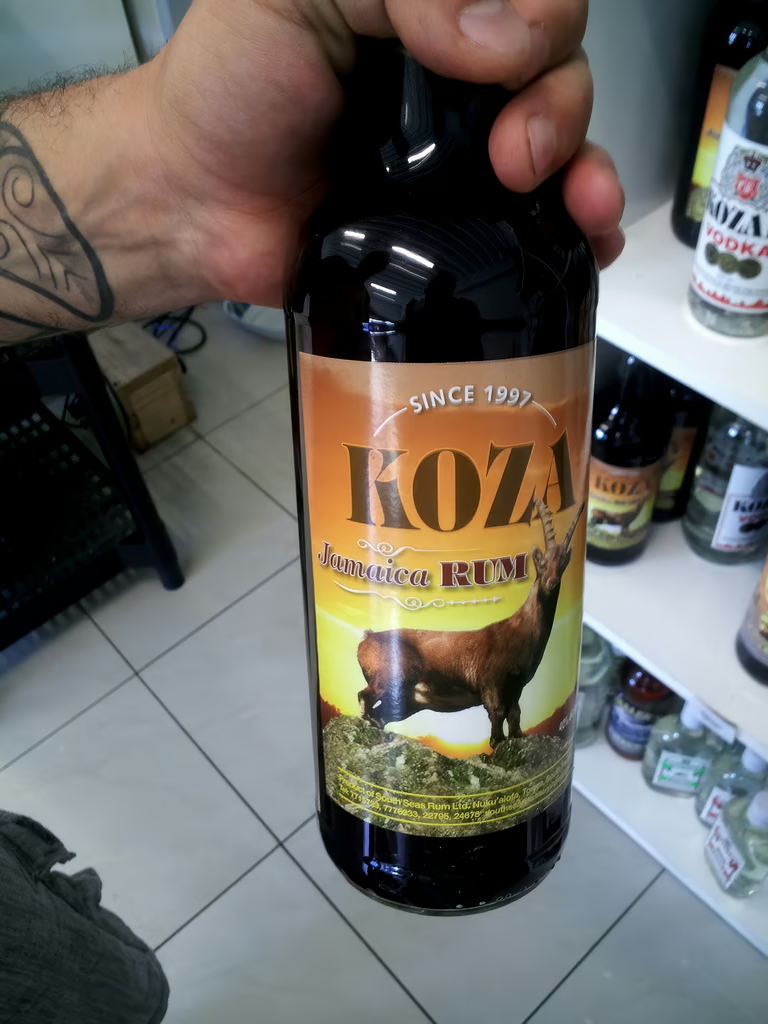
One liquor shop was painfully over-air-conditioned and expensive; perhaps its owner required every bottle to remain permanently covered in condensation. The other was operated by a substantial lady who liked to lock the door and reopen only after updating Facebook. We visited several times and each time her attention remained devoted to the screen. Unlike the first shop, however, she sold more entertaining and cheaper bottles. Choose one that looks reasonably trustworthy and the liquid really is rum rather than potato broth.
Since I have spent so long pouring words over rum, a beer interlude is unavoidable. The local range was naturally constrained by the size of the island and the number of inhabitants who enjoy beer. Closer inspection revealed the following local and imported specimens.

Maka is the local creation. For my taste it was bitter in an unfortunately posterior way, which remained a problem even for somebody accustomed to Krakonoš. I forced a few through the system but cannot claim enthusiasm. The other participant drank them two at a time and ignored my comments on quality, proving that I was the member of the action duo with the refined beer palate. No debate. Conversely I admit I had very little influence over the rum selection. Perhaps only a little.
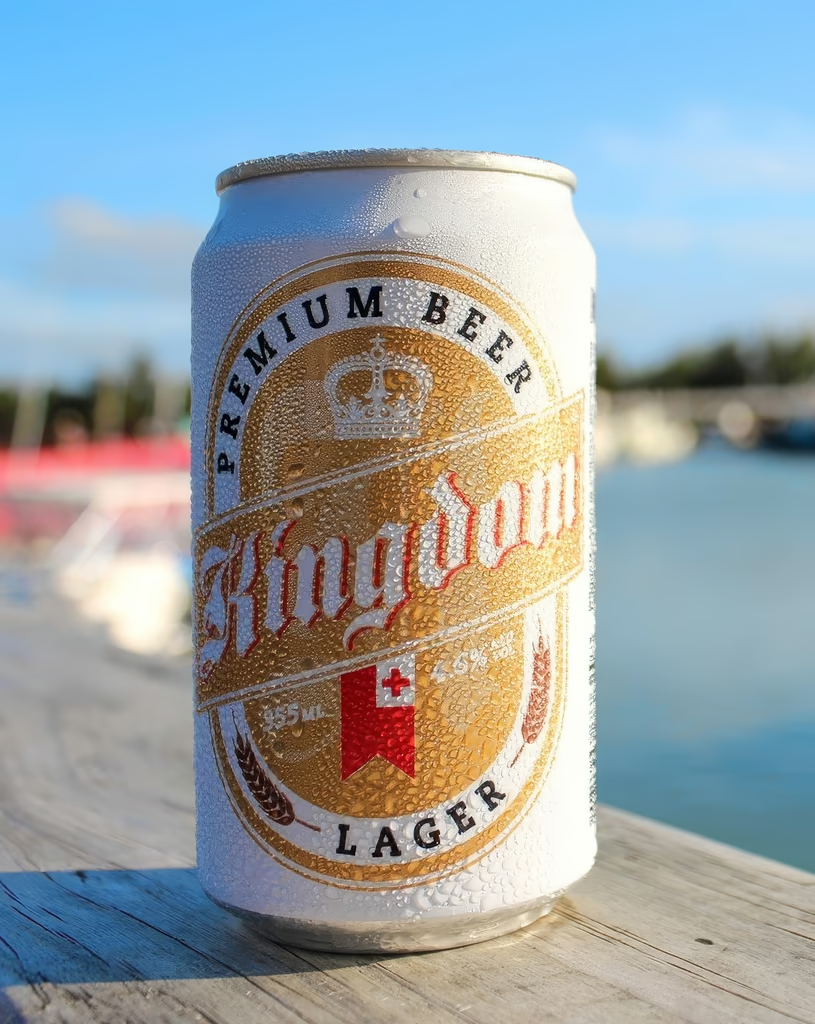
Kingdom beer is decidedly not royal. It is a faintly sweet, yellow, carbonated water, but it suits the tropical environment very well. Like a Czech ten-degree lager in sunshine, it works slowly: the drinker is not immediately demolished and is pleasantly refreshed. Availability and price were the problem. We found it only in the good restaurant, at substantially more than the average price. Like Maka it is regarded as local, though brewed outside Tonga.
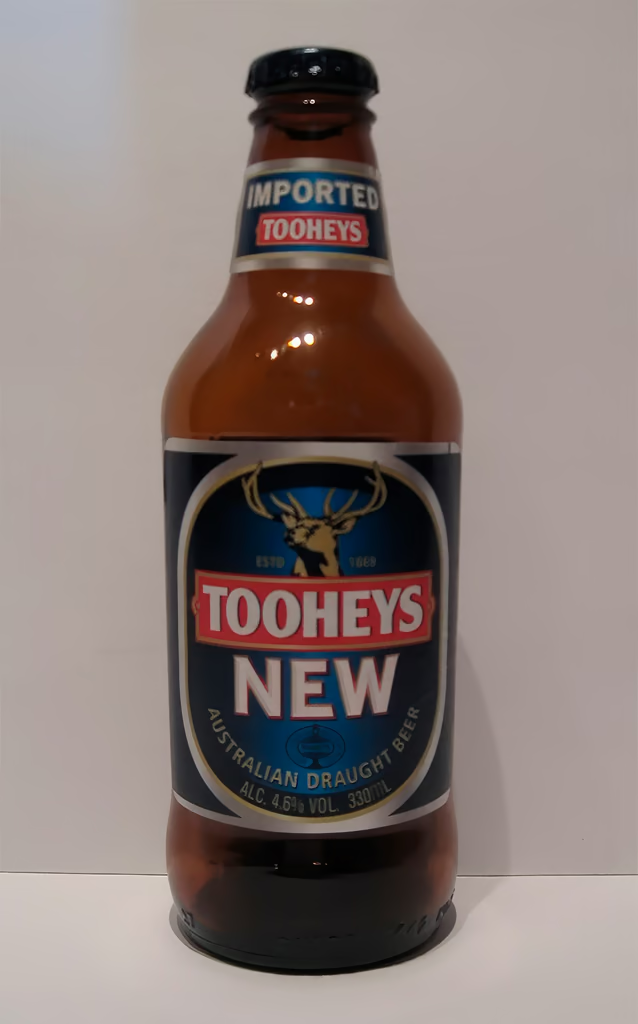
An Australian import at a very friendly four Tongalars in the bar where our plans were constructed. Its flavour was an unobtrusively weak average, but the price ensured that we drank more of this specimen than any other. There was no draught version; everything came from a bottle or can. Properly chilled, it was acceptable. Consumption usually outpaced refrigeration, however, forcing us into a lukewarm-cold variant I would not wish upon you.
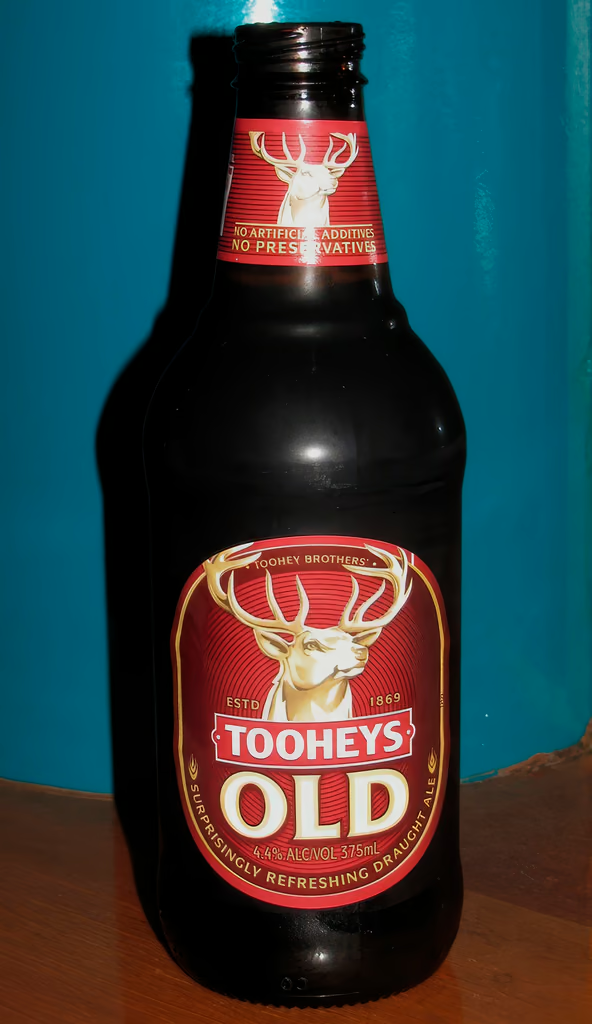
The red brother of the blue version. Unlike New, this one genuinely tasted old: a stale smell, an unhelpful bouquet, a concerning colour and, unlike most ales, an inhuman sweetness. The brewery may have intended to reproduce the tastes of an Australian penal colony—a liquid for convicts whose only remaining entertainment is the swarm of bees arriving after consumption. I abandoned it halfway down. The braver half of the expedition attempted to reach the bottom edge of the label.
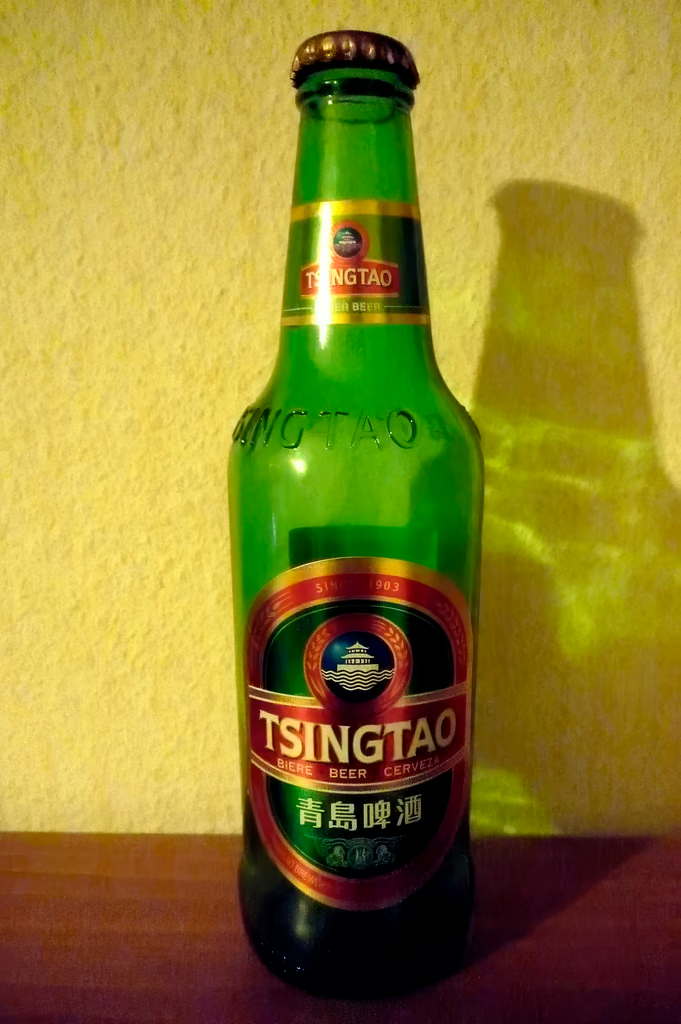
Santus has long maintained that the comrades got this one right. A Chinese-made beer with a respectable hop aroma, a flavour comfortable for Europeans, and none of the throat-scratching quality found in similar over-carbonated specimens. Tsingtao holds a high place on the Santus ranking of non-Czech beers. It drinks easily, achieves its objective effectively in 750-millilitre bottles, is attractively priced and delivers a priceless result. If you encounter it, try it.
Enough beer talk and back to the matter at hand. After the excellent local-Japanese cold cuisine we passed a few liquor shops and side streets, returned to the square and entered the proven bar. There we created the absolute best possible plan for the following days. Having spotted a scooter-rental shop, the boys decided to form an action motorcycle gang. There was a complication: to rent a vehicle in Tonga one must obtain a local driving licence.
That would not have been difficult had the magnificent idea not arrived after both of us had consumed a non-trivial number of blue-labelled beers. Filled with enthusiasm and promille, we walked to the nearest police station and requested driving permits. The reception area consisted of an extensive system of hardboard partitions and one policeman, who escorted us through the building.
If you too plan to visit the Kingdom’s traffic department, enter the police station and locate the room containing the greatest concentration of hardboard and plywood. Ignore the fist-shaped holes in the walls. Continue through the first door on the right and down the corridor to the first interrogation room, helpfully labelled Interrogation Room in three-dimensional Word 97 WordArt. Turn left through an atrium containing absolutely nothing and proceed to the peeling door distinguished by the smell of urine. That is the traffic department.
The policeman inside will explain that you are in the wrong place, applications must be made at the Ministry of Transport, he wishes you a pleasant day, and goodbye. He will not explain how to escape the labyrinth. Presence of mind, good memory and drunkard’s luck nevertheless returned us to daylight. We found a taxi and ordered it “to the ministry”.
The Ministry of Transport resembled the police station through its extensive use of hardboard, but an official waited immediately behind the entrance counter. Unfortunately he announced that we were late: the office had been closed for a full three minutes, so absolutely not. Our ultra-action plan lay in ruins. Logically we returned to the bar and continued devising any plan—even an inactive one—that might provide an alternative to the activity of the preceding two days.
Bar sitting and public observation did not trouble us, but the human body is a miraculous machine capable of rebelling when its owner demands nothing but drinking tourism. Salvation arrived in the form of a group of Germans—who else? They reminded us that our host organised a cultural and educational tour around the island with lunch. It sounded like the leaflet that occasionally appears in a letterbox promising an unforgettable excursion plus a set of titanium-diamond pans that cook by themselves. Lacking another plan, we accepted. In the spirit of Czech-German cooperation, we agreed to join the Germans.
At the appointed time plus fifteen minutes the Clown collected everybody in town and returned us to the guest house. The evening programme was traditional: loud discussion, banana, rum, the eradication of humanity and the screening of a random episode of MASH*.
It’s a banana. It always has been a banana and it always will be a banana. It’s a fruit. You unzip it and you eat it. It’s a banana! — Kryten, also known as Titan
Chapter 4: Comprehensive Reconnaissance+
Clean the oral cavity with rainwater, eat a little banana, swallow instant coffee, recall the theme of last night’s loud discussion and wait for the driver assigned to take us around the island. The supreme chief himself took the job: Toni, owner of the guest house. He was about sixty-five at the time and had energy to spare. A solid British specimen, he had first visited Tonga on holiday after seeing nowhere abroad except Scotland, liked the place for some reason and remained for the next seventeen years.
The circuit occupied the entire day, including countless scenic stops and a visit to his Beach House, also known as Toni’s Guest House Flagship House. The original article displayed a KML route here. The file itself has disappeared, but seven markers and their descriptions survived in the WordPress map tables.
Waypoints recovered from the original map
- Green House — Toni’s Guest House
- Kolovai Beach
- Mapuʻa ʻa Vaea blowholes
- Toni’s Beach House
- Site of the “partisan attack from the left”
- Pangaimotu — “the best bar in the world”
- Royal residence


There is little point describing every stop in microscopic detail, so I shall trust your imagination and select the important items.
-
The double palm. Supposedly a unique tree that grew so badly its upper part divided in two, something that had never happened anywhere else. This is why crowds of tourists visit Tonga—a crowd being at most ten passengers from each plane—to admire the miracle.
-
Lunch at Toni’s Flagship House: fish and chips. I do not wish to anticipate later results, but his fish and chips were genuinely good. Toni explained that for the Beach House he had taught the local staff a cuisine slightly different from the Tongan combination of taro, banana and coconut. In Czech terms, imagine potatoes with banana and a sprinkling on top. His effort paid off.
-
Tongan Stonehenge. A Polynesian answer to the island Stonehenge. The Pacific edition manages perfectly well with three stones arranged as an imaginary gate. No more and no less.
-
Partisan attack from the left. While reconnoitring a village containing the tomb of some king, our vehicle came under treacherous assault. A local child appeared from nowhere armed with flat stones and gravel. For his age he placed nearly everything through the open window with admirable accuracy. The Czech crew suffered no injuries; his fire was directed at the Germans in front. A clever boy and a quick learner.
Unfortunately our vehicle was entirely civilian and carried no ammunition, preventing a counterattack. If visiting Tonga, consider keeping a few paving stones in the car. Toni chose negotiation and pursued the young partisan to his hut, where he requested the direct superior—his father—and explained that the infantryman’s conduct was not ideal because, once older, he might construct a catapult.
- The beaches. Admirers of lying down and doing nothing will appreciate Tongan beaches: white sand, water in an indecent catalogue colour, reefs about two hundred metres offshore producing a constant roar, and the occasional spectacle of spray erupting into the air.


As usual the route was covered at a dignified 40 km/h, allowing us to wave at local spectators. On the way back Toni mentioned a place said to contain a great deal of food and beer. He immediately requested a transport fee, but the boys ignored the money and focused on those two nouns.
Our mental picture of a tiny restaurant behind a village, with a modest terrace overlooking the ocean, proved wrong. It was indeed a restaurant, on a beach and partly inside a cave, but the interior had been designed for more people than Santus prefers. Fortunately the number of diners was smaller than the number of available seats, promising more food and beer for us. Hired musicians supplied loud agreeable music while we waited. That interested us very little; soon the desired dinner arrived.
Most of the local products had neither flavour nor smell, apart from a handful of marine specimens and half a pig. They were welcome nonetheless. Yet, as in Czechia, when somebody drives you into the distance for a meal, you must endure the inevitable cookware presentation.

There were no pans. Instead we received a cultural performance. A group of hired entertainers carried sticks burning at both ends. This can be perfectly acceptable, provided the performers are properly trained and one is not seated in the front row. The bravest spun his stick with such determination that he dropped it several times. The audience sat less than a metre from the stage. The burning object landed here, then there, fortunately outside Czech territory.
As the saying goes, when somebody knows what he is doing it is a pleasure to watch. When he knows only approximately, one watches with horror. After fifteen minutes of spinning and smoke, the cave was filled with the smell of burning thinner—or whatever fuel the masters used. Other tourists, strengthened by local spirits and full of adrenaline, devoured the spectacle while breathing became increasingly theoretical. We welcomed the ending, boarded the vehicle and travelled back towards the green house at stately speed.

Perhaps I repeat myself, but the evening was occupied by precisely the same activity as its predecessors, with one small change: the first chance encounter. On returning to the guest house we discovered two additional residents—two women. We tactically occupied the blue table, prepared the rum and waited for a suitable opening. Our first estimate that they were yet more Germans proved surprisingly wrong.
As soon as we completed our assessment of the new tenants, they approached our table and said they had heard us speaking Czech. By coincidence they came from the same little valley. The chance of meeting Germans while travelling approaches one hundred per cent. Meeting Czechs happens too—usually when somebody behind you in a queue says, “Damn, this is going to take forever,” or a group nearby celebrates cheap beer. Meeting two of them in the middle of Tonga is genuine luck.
Naturally ours had to be a special coincidence. One woman worked for the same Prague company as the second member of our expedition; the other had attended the same school as Santus. In plain language, Tonga brought together two people from one Prague firm and two alumni of the Trutnov grammar school. You can imagine the resulting evening. Yes, all the rum was finished.
Chapter 5: Beach House Trip+
Getting up was not easy, but instant coffee and a banana will place a person on his feet. We immediately informed the ladies of a place suitable for doing nothing—Toni’s Beach House—and arranged with the Clown for transport later that morning. A German fellow traveller joined us. For somebody who said she was nearing retirement, she was remarkably active. Our quartet plus one external member departed at the agreed time plus twenty-five minutes.
I shall not exhaust an already tired reader with the details of our inactivity, but one event deserves mention. After some short-term loafing on the beach and in the adjoining jungle, we noticed a figure swimming past. It received little attention until, out in the open sea, it turned and began approaching our territory. Meanwhile we dealt cards, chose a simple game and waited for lunch.
The person who emerged from the ocean offered the polite formula, “Hi there, how are you?” and nothing more. We continued playing until the swimmer addressed us in fluent Czech: “Well, could I join you? I’m Radek from Zlín.” The Czech-versus-German score for the previous three days was now 5–3.

The remainder of the day was filled with purposeless talk. It produced a plan: Radek would remain at the Beach House for one more night and join us the next day. The women, thoroughly tired by our conversation, rejected the proposed joint excursion somewhere around the island. The gentlemen’s trio had its action plan.
Our original duo plus the two women inspected the neighbouring beaches and returned to the green dump and its blue table. Both beer and rum were gone. We attempted to replace loud conversation with social games—cards, dice and a small fishing game—and the tasting of some white wine. But let us be honest: beer is beer and rum is rum.
Chapter 6: Da Best Bar — Whole-Day Trip
The shortage of quality drink produced a surprisingly smooth awakening. Radek appeared at our dwelling at the appointed time. Together we consumed the established instant-caffeine-and-banana breakfast and, during digestion, decided where to go.
The plan had two phases. Phase one was transport to the only local harbour. There it would flow directly into phase two: identify a vessel travelling towards some island. Both phases proceeded with unexpected ease. We reached the royal harbour and boarded a boat for Pangaimotu.
That morning the Clown had supplied ample information about the local infrastructure: no road, sand everywhere, many palm trees, a warm lagoon, one shipwreck and a bar-like hospitality establishment. At first this seemed insufficient for our needs. Upon anchoring in front of the bar, the gentlemen’s trio reversed its opinion by 180 degrees. A warm welcome, combined with information about the supply of permanently chilled beer, rum and coconuts, sent a wave of enthusiasm through the group. We proudly secured a strategic table, checked the contents of our pockets and began ordering. Can you imagine starting the day at half past ten in a beach bar overlooking a lagoon, with a rusting wreck in the foreground?


It took exactly three beers and two rums to get us into the water. The lagoon was astonishingly warm and perhaps slightly saltier than usual, effectively supporting not only anorexic-bulimic silhouettes but also figures of the barrel, boar and minor-baron class. You float in offensively warm water, a full bottle beside your head, the bar close by and no people anywhere except the other two gentlemen. What more could one request?


Before long, two members became hungry and the third man’s beer became warm. We returned to the table and ordered anything edible. The obvious choice was fish and chips, if only to determine whether the kitchen could beat Toni’s Beach House.
The chef apologised that he could not name the catch of the day because no catch had yet occurred. He exchanged his jacket for swimming trunks and a spear and went out to procure lunch. Twenty minutes later he returned with three extremely fresh meals; after another twenty they were on our plates. Whenever a European restaurant assures me that its fish is fresh, I remember this event and smile at the liar. Less than forty-five minutes separated the beginning of our digestion from the fish’s unsuspecting movement through the lagoon.
I have little idea what the cook did to it, but the result was supreme. Fish pairs beautifully with white wine, so naturally we ordered beer and a rum digestif. They too suited the meal, especially in quantities greater than one.
During the afternoon we attempted to move beyond direct sight of the bar. Yet every walk towards the island’s bend lasted more than ten minutes. In that time one man’s beer warmed, another man’s legs began to hurt, and the third forgot his shoes or needed to visit the sort of place even the Queen approaches on foot. Bar-based idleness gained an entirely new dimension on this island. I can safely say that nobody regretted leaving almost all his spending money there.
After landing back at the royal harbour hunger returned. The fish market provided a timely solution, where one gentleman noticed a promotional offer on fresh lobsters: six for forty Tongalars. Everyone was so excited by the discovery that our shared experiences—and the declining proportion of blood in the alcohol—required support at the familiar drinking establishment on the central square.
Three gentlemen carrying a plastic bag full of lobsters were not going to walk. We selected—and this was my idea—a taxi identical to the vehicle Santus had owned in New Zealand between 2011 and 2012: a Mazda MPV three-litre V6. My version, admittedly, possessed all its components, four tyres of the same brand and an appropriate quantity of air. The Tongan edition resembled a repeatedly crashed custom project.
The driver tried to start it for three determined minutes, gave up, left us and the lobsters inside, and disappeared. Five other taxi drivers immediately surrounded the vehicle, perhaps to create the impression that repairs were in progress or to prevent our escape. Fortunately our man returned after a few minutes with a miraculous engine-starting spray. He applied the miracle to the motor and succeeded on the second attempt.
Perhaps the driver was disappointed that such a performance earned only a 500-metre journey, but business is business. Minutes later we stood before the known establishment and assessed the expedition. The decision was unanimous: a major success.

On the way home we acquired digestifs appropriate to lobster. I no longer remember whether the Clown returned us to the guest house—during our evaluation we probably met the German couple from the island circuit—or whether we hired another taxi. In either case the desired result, transport to the green house, occurred.
Cooking the lobsters was straightforward: find an enormous pot, force all the creatures into it, have the other man maintain the flame while I supplied expert commentary from the side. The delicacy was ready in less than fifteen minutes. The Rolls-Royce of the sea tasted excellent. Radek honoured us with a visit and, properly brought up, supplied aperitifs; we provided the digestif.
The women joined us but claimed the delicacy smelled. Our alcoholic aroma did not improve their assessment and no romantic engagement occurred. They proposed visiting the main church the following morning. Their intention was presumably cultural and spiritual enrichment. For us, the idea formed a suitable foundation for an extensive discussion of communion wine. We promised nothing, though somebody may have uttered a vague expression of possible cooperation.
The green house had begun to look too familiar, so we welcomed a move to the blue house. The green version was hut-like, shack-like and faintly grubby. Toni also owned a yellow house equipped rather better. The trio was completed by the locally luxurious blue edition. Radek had taken a room there—fortunately for us—so one evening’s move from mud and dirt to the premium district received an enthusiastic response from our tandem.
Of course you should! You’ve got a tiled bathroom, cork floors, a terrific barbecue in the garden, double glazing, a telephone—everything! — Lister
The rest of the evening passed in conversation about the backside of a Japanese woman staying in Radek’s house, work, travelling and other matters now forgotten. One thing is certain: it was not quiet.
Chapter 7: Recovery Day
This will be a short chapter. Yesterday’s heroic performance left a considerable mark on the gentlemen of the Czech community, so the cultural expedition became a recovery morning. There was one exception: a sufficiently resilient, cultured and independent person. Put simply, me.
Only I forced myself out of bed to honour some vague promise concerning the church. My motivation did not arise from a desire for spiritual fulfilment. Fulfilment was indeed the objective, but in a more secular part of Santus. I wanted food.
It was Sunday. Everybody, including the King, was in church, leaving very few people to operate restaurants. I searched the whole town—three blocks in every direction from the square—and found two shops capable of satisfying the desire to fill myself with anything. Adequately fed, I reached the main church and waited for the women to finish admiring its splendour.
Toni appeared in the car park and improved the wait with a monologue of complaints and a comprehensive inventory of his staff’s shortcomings. Little happened after our return to the green house. The other man came alive around noon. Radek stopped for morning-lunchtime coffee and announced his intention to return to the Beach House: we would leave soon, he had no wish to acquire instant cirrhosis in a developing country in the Pacific, and the women had also departed, saying we smelled and their evening flight was approaching.
One participant spent the day reading while the other slept. Then they exchanged positions, continuing until evening. A modest wine tasting followed. Toilet, shower, bed.
Chapter 8: The Penultimate Day
At first the penultimate morning looked identical to the recovery day. Then the other man produced a relatively sensible idea: return to the bar on the small island opposite the main one. More importantly, the plan required far less spending money than our first visit. We would drink one or two coconuts, take a banana as a snack and do nothing. At most we might walk around the island. It was genuinely small and should be manageable while sober.
The same boat carried us across. On arrival the bar staff began smiling in a peculiar way, presumably expecting a repeat performance. An order for chilled coconut visibly startled them. Coconut refreshment, a spell of inactivity, and then the promised circuit.
The walk lasted twenty minutes along white sand with an occasional stone, tyre, plastic bottle or piece of driftwood. At least we fulfilled the commitment made on arrival—to be slightly more active than before. The objective was achieved: once around, another coconut, no substantial exertion, a period of wallowing in warm water, a final coconut, goodbye, and the boat back to the main island.
That evening we packed the accumulated mess, drank a beer and went to sleep. In the morning we washed, Toni drove us to the airport, we thanked him for unforgettable experiences on every level, waited beneath a palm and flew away.
Final Evaluation: What Is Tonga Like?
Instead of a long explanation, a familiar quotation will do. Those who do not recognise it may consult their preferred search engine.
It’s a trap! — Admiral Ackbar
But no…
Tonga is a good place. It is remote, but that is simply what it is. If you are going to Tonga—and I believe I speak for both of us—leave the main island of Tongatapu. It contains the capital, but like many Pacific capitals this is largely an administrative area in which very little can be found. Head to the northern islands.
Flights are available, though nobody told us encouraging things about the service or reliability of local carriers. Ships are also available, cheaper and perhaps safer. Everyone we met during our stay spoke favourably about the northern islands, so there must be something to it.
Our conclusion can be summarised as follows:
The main thing is to understand where you are and where you are going. It is the back end of nowhere, but even the back end of nowhere can be excellent if you arrange it properly. And don’t bring bananas. — San-Tus & Umi